
We Built a Local AI Machine on a Public Holiday
A small Mac Mini, a few open AI models, and one simple question: what happens when company AI stays inside the company?

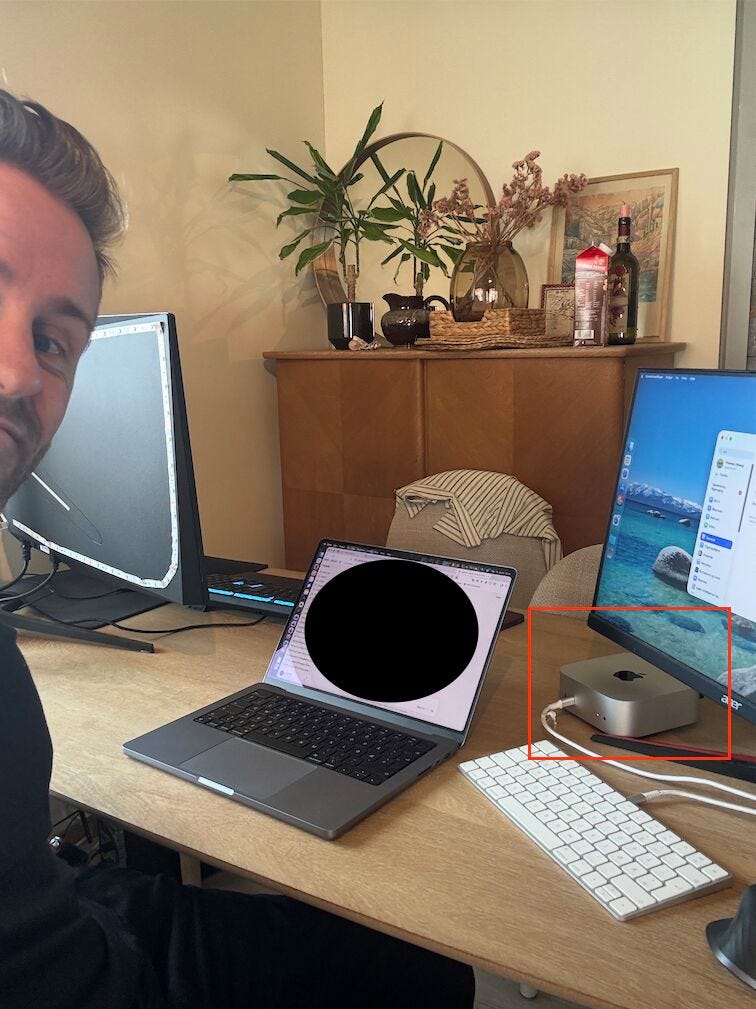
There are probably more normal ways to spend a public holiday, but for us this turned into one of those days where curiosity took over and the hours disappeared. While many people were relaxing, hiking, or catching up on things at home, we sat down with a Mac Mini and started building a local AI machine.
Together with co-founder (and brother) of Nrth AI, I spent the day testing something I think will become incredibly important for companies over the next few years: AI that does not live somewhere else, but works inside the company’s own environment. We installed and tested several AI models, including Gemma and Qwen, in different sizes, and then added company-specific data so the setup could work with internal information instead of only general internet knowledge.
The most interesting part was not simply that the models worked. The interesting part was that everything ran locally. The data stayed on the machine and was not sent to OpenAI, Anthropic, Google, Microsoft, or any other external platform. It was not uploaded into a random SaaS tool, and it was not floating around somewhere outside the company’s control.
That changes the conversation around AI for businesses. For a long time, most of the discussion has been about which AI tool a company should subscribe to. Should they use ChatGPT, Claude, Gemini, Copilot, Perplexity, or something else? That is still a relevant question, but I think the more important question is starting to become: how do we build AI that works with our own data, inside our own environment, according to our own rules?
That is where local AI becomes really interesting. Not every company can, or should, send sensitive operational data, customer information, contracts, internal documents, financials, product data, or intellectual property into external AI platforms. For many businesses, that is not only uncomfortable. It may also be difficult because of regulation, security requirements, customer trust, or competitive advantage.
At the same time, those companies still need AI. They still need smarter workflows, better internal search, faster analysis, and systems that can help employees understand and act on company information. They need AI that can support real work, not just answer general questions in a chat window.
That was what we wanted to test. Could we take one small machine, run several AI models on it, connect it to company-specific data, and create something useful that only runs locally? After spending the day building and testing, the answer felt very clear: yes, this is possible, and it is only going to get more powerful.
Of course, it is still early. The setup is not perfect, and it is not yet a polished product. But it was enough to show where this is going. I do not think the next big step in AI will only be bigger models and better chatbots. I think one of the biggest shifts will be companies building AI systems that actually fit their own workflows, their own rules, and their own security requirements.
AI will move closer to the business. It will become less about subscribing to another tool and more about building intelligence into the company’s own infrastructure. For some companies, that might mean local models. For others, it might mean hybrid systems. But the direction is clear: businesses will want more control, more ownership, and more AI that understands their actual work.
That is what we are exploring with Nrth AI and The Agent Layer. We are building, testing, failing, improving, and sharing what we learn along the way. Sometimes that means spending a public holiday with a Mac Mini, several open models, too much coffee, and a strong feeling that this is the beginning of something important.
If you are interested in local AI, AI agents, secure AI systems, or what it actually looks like to build an AI-native company from the ground up, I would love for you to subscribe and follow along. I will keep sharing the journey as honestly as possible, including what works, what breaks, and what we learn while building.