
The Missing Layer in AI: Why Context Changes Everything
We made AI smarter, but we forgot to make it remember. Model Context Protocol (MCP) might be the shift that turns AI from a tool you use into something you actually work with.

The Day I Realized AI Doesn’t Just Need to Be Smarter — It Needs to Remember
A few weeks ago, I ran into a problem that I think a lot of people working with AI quietly accept, but rarely question.
I was deep into building something. I had explained my setup, my idea, the structure of the system, and what I was trying to achieve. The AI I was using was incredibly helpful. It understood the direction, made good suggestions, and actually felt like something I could work with, not just use.
Then I opened a new session.
And everything disappeared.
Not the output. Not the code. Not the documents.
But the understanding.
It felt like sitting down with a brilliant colleague who forgets everything the moment they leave the room. Every conversation starts from zero. Every explanation has to be repeated. Every workflow has to be rebuilt in words.
That was the moment I started looking into something called Model Context Protocol, or MCP.
And once you understand what it is, you start to see why it might become one of the most important layers in how we build and use software going forward.
What MCP actually is
At its core, MCP is surprisingly simple.
It is a way to give AI systems structured, persistent context so they can understand what is happening across tools, sessions, and workflows.
Not just isolated prompts.
Not just one-off answers.
But the ongoing story of what you are doing.
When we talk about “context” in AI today, we usually mean the text you provide in a prompt or the conversation history in a single session. MCP takes that idea and expands it into something much more powerful. It allows context to exist outside of a single chat window and instead live as a shared layer that different tools, systems, and agents can access and build on.
In practice, that means the AI does not just see the last message you wrote. It can understand your project, your data, your workflows, your goals, and how everything connects.
It moves from reacting… to actually being aligned.
Why this matters more than it sounds
Right now, most people are using AI in a very fragmented way.
You explain your business.
You explain your problem.
You explain your setup.
And then you do it again the next day. And the next.
We have accepted this as normal because the models are so powerful that it still feels useful. But if you step back for a second, it is a strange way to work. Imagine having to rebrief a team member from scratch every single time you talk to them.
That is essentially how we use AI today.
MCP changes that dynamic.
Instead of treating AI like a tool that lives inside a single session, it becomes something that can stay connected to your work over time. It understands where you are in a process, what has already been done, and what still needs to happen.
That shift might sound subtle, but it completely changes the experience.
You are no longer just asking for help.
You are collaborating.
How it works (without overcomplicating it)
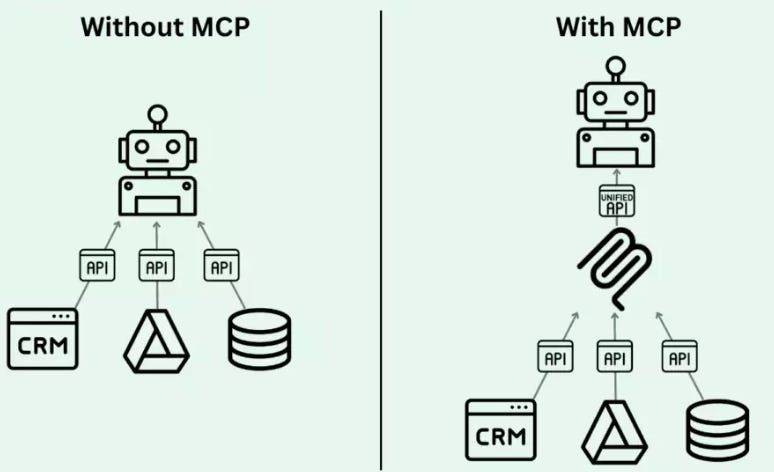
The easiest way to understand MCP is to think of it as a shared “context layer” that sits between your tools and your AI.
Normally, your setup might look like this: you have a database, maybe a CRM, some documents, a frontend, and an AI tool on the side. Each of these systems knows its own piece of the puzzle, but nothing really ties it all together in a way the AI can fully understand.
With MCP, you introduce a structure where context is organized and accessible. Your systems can read from it and write to it, and the AI can use it to make better decisions and take more relevant actions.
Instead of manually stitching everything together through prompts, the context is already there.
So rather than saying:
“Here is my data, here is my setup, here is what I want to do…”
You define that once, and the system keeps track of it.
Over time, this becomes less about prompting and more about operating within a system that already understands what is going on.
What this looks like in real use cases
This is where things start to get interesting, because MCP is not just a technical improvement. It changes what is actually possible.
Take something simple like sales.
Without MCP, you might ask an AI to write a follow-up email. You give it a bit of context, maybe copy in some notes, and it produces something decent.
With MCP, the AI could already understand your pipeline. It knows which leads you are working on, what has been sent, who has opened what, and how long it has been since the last interaction.
So instead of asking for a generic email, you get something much more precise. The system might suggest that a specific lead has shown interest but is hesitating, and propose the exact next step based on previous interactions and your typical sales flow.
It stops being a writing tool and becomes part of the process.
Another example is building products.
If you are developing an app today, you often jump between tools: code editors, design tools, documentation, APIs, and AI assistants. Each time you ask for help, you have to reintroduce the context.
With MCP, the AI could understand the structure of your application, the components you are working on, and the decisions you have already made. It can suggest changes that actually fit your architecture, not just generic solutions.
It feels less like asking questions and more like working alongside someone who knows the project.
What this means for the future
I think MCP points toward a bigger shift that is easy to miss if you only look at model improvements.
For a long time, software has been something we operate. We open an interface, click around, move information, and tell the system what to do.
AI started to change that by giving us systems that can respond and generate.
But MCP pushes it further.
It enables systems that can stay aware of ongoing work, across time and across tools.
When that happens, a few things start to change.
Workflows become simpler because you do not have to manually connect everything. Interfaces become less important because the system already understands what you are trying to achieve. And most importantly, AI becomes capable of taking more meaningful actions, not just giving suggestions.
This is where the idea of “agents” actually starts to make sense in practice.
Because an agent without context is just a clever assistant.
An agent with context can actually operate.
The bigger picture
If you zoom out, MCP is not just about memory. It is about coordination.
It is about creating an environment where AI systems can understand not just individual tasks, but the processes those tasks belong to.
That might not feel revolutionary at first glance. But if you have ever felt the friction of repeating yourself to AI, or the gap between what you are doing and what the system understands, you start to realize how big this shift actually is.
For me, it changed how I think about building with AI.
Not as something you prompt.
But as something you set up to understand, and then let it move with you.
And that is a very different kind of software.